
Chocolate Factory Capacity Verification: 7 Questions for Annual Contracts

Entering into an annual supply agreement for high-volume confectionery requires absolute clarity regarding manufacturer output. A supplier claiming substantial overall tonnage on a marketing brochure does not guarantee that your specific SKU will clear manufacturing schedules during peak demand quarters. Performing a methodical chocolate factory capacity verification protects procurement teams against unexpected stockouts, delivery delays, and costly retail penalties.
Theoretical nameplate capacity often diverges significantly from actual commercial output. Line changeovers, sanitation cycles, mold cooling durations, packaging line bottlenecks, and routine maintenance all reduce effective capacity. To safeguard your supply chain, procurement managers and brand owners must look past general volume assertions and examine line-level engineering realities.
Why Chocolate Factory Capacity Verification Protects Annual Contracts
When buying organizations commit to multi-million-dollar supply agreements, factory output assumptions must be backed by verifiable data. A successful verification process establishes whether a manufacturer can absorb seasonal demand surges, manage product variations, and maintain stringent quality controls under high-speed operation.
Evaluating industrial capacity requires a deep dive into active line configurations, shift structures, process bottlenecks, and quality assurance workflows. The following seven questions establish a concrete framework for evaluating contract manufacturing capabilities.
Question 1: How Many Dedicated Lines Operate and What Is the Total Output?
Gross factory volume must be broken down by active production lines and specific product formats. High overall tonnages mean very little if molding, enrobing, and packaging lines are shared across conflicting SKU formats such as solid bars, filled pralines, and drops.
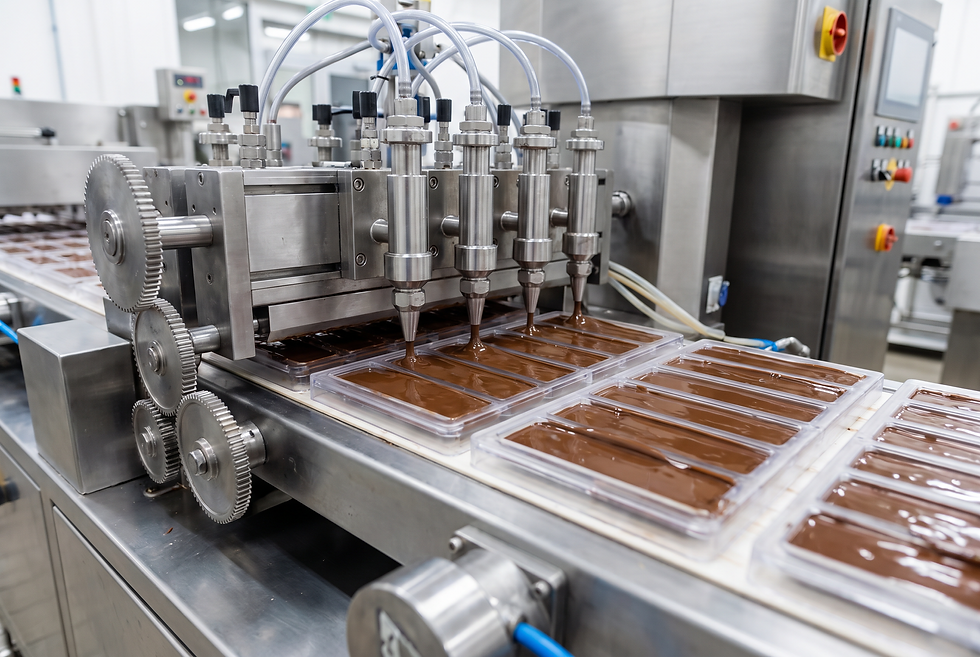
When conducting a technical audit, verify actual equipment footprints and factory floor space. For example, at SFKS, manufacturing infrastructure comprises 12 fully automated production lines delivering a daily production capacity exceeding 120 tons. This multi-line architecture provides dedicated lanes for distinct chocolate formats, ensuring continuous throughput without frequent interruptions for line retooling.
Question 2: What Shift Structure and Utilization Rates Base the Daily Metrics?
Nominal daily output figures must always be tied to specific shift models. A facility producing 100 tons across three 8-hour shifts at 95% line utilization operates under extreme stress, leaving virtually zero buffer for unexpected mechanical delays or urgent volume spikes.
Single or Dual Shift Operations: Leaves natural room for capacity expansion by adding an extra shift during peak quarters without capital expenditure.
Continuous 24/7 Production: Requires strict verification of scheduled preventative maintenance intervals and planned downtime.
Overall Equipment Effectiveness (OEE): Request historical OEE data; well-managed industrial facilities typically target availability rates between 80% and 88%.
Question 3: Where Are the Process Bottlenecks in Refining and Molding?
Chocolate manufacturing involves sequential thermodynamic and mechanical stages: mixing, refining, conching, tempering, depositing or enrobing, cooling, and packaging. Output is always constrained by the slowest unit operation in this chain.
Production Stage | Core Equipment | Common Capacity Bottleneck | Verification Checkpoint |
Refining & Conching | Ball mills / 5-roll refiners & longitudinal conches | Insufficient conching tank volume for fine mass preparation | Batch cycle times vs. continuous holding tank capacity |
Tempering & Molding | Continuous temperers & automated cooling tunnels | Cooling tunnel dwell time limiting belt conveyor speed | Tunnel length, refrigeration zone control, and belt width |
Primary Packaging | High-speed flow wrappers & cartoning systems | Manual packing stages unable to match high-speed cooling discharge | Automatic feeding systems, multi-head weighers, and cartoners |
Quality Assurance | In-line checkweighers, X-ray & metal detectors | Inspection reject loops causing backpressure on primary wrappers | Real-time sensor speeds and automated reject logging mechanisms |
Question 4: Does Secondary Packaging Throughput Match Primary Mass Output?
One of the most frequent oversight areas in factory capacity audits is packaging integration. A molding line capable of turning out 15 tons of chocolate tablets per shift will stall if primary flow wrapping, secondary display boxing, and palletizing lines can only process 10 tons.
Confirm that automated packaging feeds match primary output rates directly. If manual boxing or hand-applied labeling is required for retail displays, inspect dedicated staffing allocation and physical staging areas to ensure secondary packaging does not create physical line blockages during high-velocity production runs.
Question 5: How Is Production Allocated and Scheduled During Peak Seasons?
Seasonal demand peaks in the chocolate industry—particularly ahead of Christmas, Easter, Valentine's Day, and major retail holiday cycles—put immense pressure on contract manufacturers. Factories without disciplined capacity allocation systems frequently overcommit lines to multiple buyers simultaneously.

Ask the prospective manufacturer for their capacity reservation framework:
Firm vs. Rolling Forecasts: How far in advance must volume commitments be locked into the master production schedule (MPS)?
Line Dedication Agreements: Are specific lines reserved exclusively for your contract during key production months?
Buffer Capacity Policies: Does the factory maintain an unallocated capacity buffer (e.g., 10%–15%) to manage sudden reorders or seasonal surges?
Question 6: What Quality Control Protocols Operate at Line Speed?
High production capacity is counterproductive if line speed compromises product specifications, fat bloom stability, or food safety parameters. Quality control cannot be treated as an isolated end-of-line checkpoint; it must be integrated throughout continuous high-speed runs.
Review the manufacturer's in-line analytical and inspection measures. Essential data points include automatic tempering index monitoring (tempermeter logs), continuous viscosity checks, in-line metal detection, and X-ray inspection for foreign body prevention. Verify that the QC team has the operational authority to halt high-tonnage lines immediately upon detecting parameter drift without waiting for post-shift laboratory releases.
Question 7: What Equipment Redundancy and Preventive Maintenance Systems Exist?
Unplanned mechanical downtime on a single-line facility can delay deliveries for weeks. Industrial chocolate supply contracts require clear evidence of equipment redundancy and robust preventative maintenance routines.
Evaluate the manufacturer's asset reliability framework. Key indicators of enterprise stability include duplicate tempering units, redundant cooling compressors, on-site spare part inventories for high-wear components (such as depositor pistons and servo motors), and documented preventive maintenance schedules. When working with large-scale facilities operating 12 fully automated lines, lines can be cross-utilized to provide immediate production failover if a mechanical issue arises on a specific belt.
FAQ
What is the difference between theoretical and effective chocolate factory capacity?
Theoretical capacity is the maximum output a machine can produce under continuous 24/7 running without any stoppages. Effective capacity accounts for scheduled maintenance, product changeovers, allergen cleaning cycles, cooling dwell constraints, and packaging line balance, reflecting the real volume available for commercial delivery.
Why is cooling tunnel length critical during chocolate factory capacity verification?
Cooling tunnel dwell time dictates the speed of the entire molding line. Chocolate requires controlled, gradual crystallization to prevent fat bloom and ensure proper demolding. If the cooling tunnel is too short or lacks sufficient refrigeration zones, running the line faster causes demolding defects and packaging jams.
How do automated multi-line factories mitigate supply chain risks for annual contracts?
Facilities with multiple automated lines, such as SFKS with 12 production lines producing over 120 tons per day, reduce reliance on single machines. They can dedicate specific lines to high-volume SKUs while providing immediate redundancy and line reallocation if an unexpected maintenance issue occurs.
What documentation should procurement teams request to verify factory capacity claims?
Procurement teams should request master production schedule (MPS) samples, line layout diagrams, shift structure breakdowns, equipment nameplate ratings, historical Overall Equipment Effectiveness (OEE) logs, and preventative maintenance audit records.
Verify Factory Capacity Before Your Next Annual Contract
Ensure your supply chain stability with verified manufacturing data. Request the Factory Capacity Verification Sheet and SFKS production profile to inspect our 12 automated lines, daily 120+ ton capacity, and certified quality workflows.


Comments