
Why Global Importers Choose a GMP Cleanroom Chocolate Manufacturer for High-Margin Success
- Yun Hong

- Jul 18
- 5 min read
For global chocolate importers and retail brand owners, the greatest sourcing risk in today’s market is not a lack of supply. The real challenge lies in finding products that bypass the low-margin commodity price wars, maintain compliance under rigorous inspection, and prevent costly shelf-life recalls. Sourcing from a facility that lacks standardized contamination control can result in mold issues, allergen cross-contact, and failed supermarket quality assurance inspections.
That is why partnering with an established B2B GMP cleanroom chocolate manufacturer has transitioned from a premium preference to an absolute operational necessity. To secure high-margin retail placement, global brands must ensure their supply chain is built on certified environmental safety and advanced production design.
Why Global Food Importers Cannot Risk Non-GMP Chocolate Production
When importing confectionery into high-demand regions like Europe, East Asia, and the Middle East, product quality is audited long before the shipping container arrives at the port. Standard food manufacturing facilities often struggle with atmospheric control. Variations in humidity and airborne micro-particulates can lead to early-stage fat bloom, condensation damage, and microbial growth in chocolate coatings.
Furthermore, global supermarket chains and convenience stores require extensive documentation to verify food safety standards. Working with an uncertified facility increases the risk of failed importing reviews, leaving your shipment stuck at customs or rejected during retail QA evaluations. Choosing a specialized food safety certified chocolate manufacturer mitigates these structural risks, ensuring that your products satisfy strict regulatory thresholds from day one.
What to Audit: Key Criteria of a Certified 100,000-Class Cleanroom
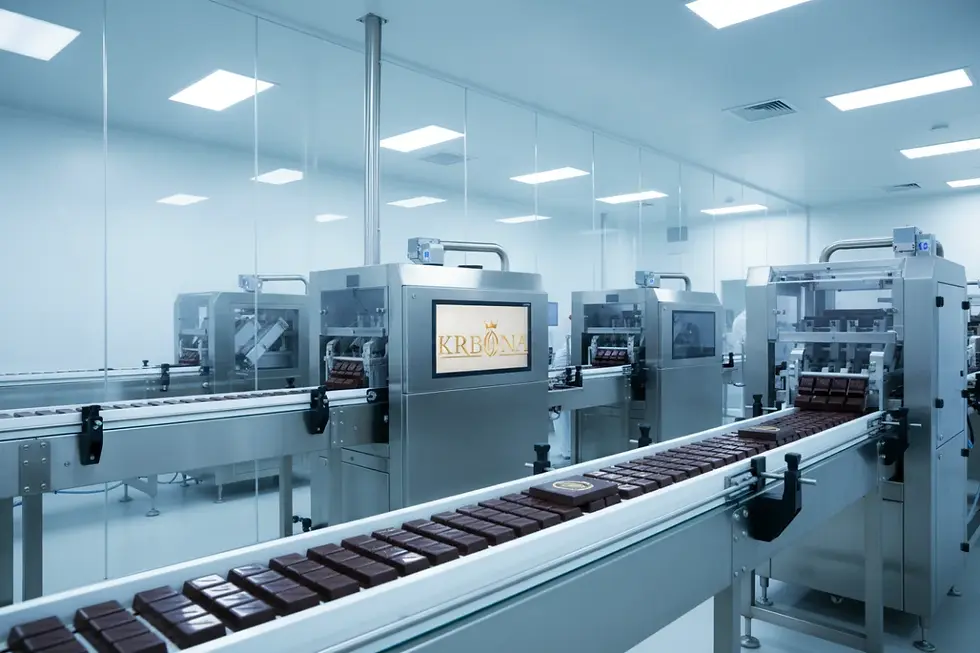
Not all confectionery factories operate at the same level of safety. When executing a private label chocolate QA audit, procurement teams should verify the technical characteristics of the production environment. A premium manufacturer must maintain a 100,000-class GMP cleanroom—meaning the facility limits airborne particulates, regulates air changes per hour, and enforces strict employee hygiene entrance protocols.
Key features of a high-performance cleanroom include:
HEPA Filtration Systems: Continuous air purification to remove micro-particulates and dust.
Positive Pressure Control: Preventing external, untreated air from entering sensitive processing areas.
Temperature and Humidity Calibration: Crucial for managing the tempering process, preventing surface moisture, and stabilizing compound chocolate coatings.
The Risk Mitigation Matrix: Standard Facility vs. GMP Cleanroom Manufacturer
Understanding the differences in operational standards helps buyers calculate the direct impact of manufacturing quality on their retail margins. Confectionery sourced from sub-par facilities carries hidden costs that erode profitability.
Buyer Concern | Standard Chocolate Factory | GMP Cleanroom Chocolate Manufacturer | Margin & Compliance Impact |
|---|---|---|---|
Microbial Contamination | High risk of yeast, mold, and airborne pathogen contact | Sterile, positive-pressure air filtration | Drastically reduces sourcing risk and product recall liabilities. |
Allergen Cross-Contact | Shared lines without air containment zones | Segregated processing zones and strict cleanup protocols | Clear labeling confidence, ensuring trouble-free supermarket distribution. |
Shelf-Life Stability | Inconsistent moisture levels causing sugar bloom | Controlled humidity levels during cooling and packaging | Extends shelf life, protecting retail margins over long-distance logistics. |
QA Audit Approvals | Frequent failures during detailed third-party audits | Standardized chocolate factory GMP standards with transparent documentation | Faster product launch cycles and smooth entry into major retail networks. |
How SFKS Combines 100,000-Class Cleanroom Standards with Scalable Chocolate Production
At SUZHOU SFKS FOOD CO., LTD (SFKS), we do not treat food safety as an afterthought; it is the cornerstone of our manufacturing philosophy. We operate advanced automated lines within a specialized 100,000-class GMP cleanroom chocolate manufacturer facility, turning strict environmental controls into a competitive market advantage for our global B2B clients.
By combining technical compliance with our versatile OEM/ODM capabilities, SFKS supports private label brands and distributors in launching innovative, high-margin products. Whether you are distributing our flagship ice cream-flavored crispy cones, premium chocolate-coated nuts, or bespoke 3D custom-molded chocolate figures, our cleanroom environment ensures every batch matches your precise sensory and safety requirements.

Our extensive manufacturing infrastructure enables us to translate high-tech assets into direct business value for our partners:
Scalable Output without Disturbance: Our automated production lines yield a daily capacity of 120+ tons, allowing us to support bulk regional rollouts and major seasonal campaigns without bottleneck delays.
Fast-Track Sample Approval: Our in-house CNC tooling team creates custom 3D chocolate prototypes in just 48 hours, enabling rapid market testing and accelerated approval cycles.
Uncompromised Certification: As an established HACCP certified chocolate supplier, we provide full export compliance documentation, including Halal certifications, to unlock premium retail doors across Southeast Asia, Korea, and the GCC region.
The Ultimate QA Checklist for Importing Certified Chocolate Products
When evaluating a potential confectionery partner, use this operational checklist to ensure they meet international trade expectations:
Verify Facility Certifications: Request active certificates for ISO 22000, HACCP, and GMP to confirm third-party regulatory validation.
Inspect Environmental Controls: Ask for data logs showing temperature and relative humidity levels inside the cooling and packing areas.
Request Material Safety Data Sheets (MSDS): Ensure all raw ingredients and compound coatings meet cleanroom processing standards.
Confirm Traceability Protocols: Check how the supplier tracks raw materials through the production stages to isolate quality variations quickly.
Evaluate Custom Packaging Capabilities: Verify that secondary packaging is designed to maintain cleanroom hygiene levels during long-distance shipping.

Secure Your Next Compliant Chocolate Line with SFKS
Working with an elite, certified manufacturer protects your brand reputation and secures premium retail shelf space. SFKS takes the complexity out of custom chocolate sourcing by merging cleanroom hygiene standards with innovative product development.
Stop compromising on compliance and risking your retail margins with standard facilities. Let our team engineer a secure, high-quality, and visually distinct chocolate portfolio customized for your target market.
Follow SFKS for more premium chocolate OEM insights:
Website: https://sphinxcandy.com
YouTube: https://www.youtube.com/@Sfks_Candy
Instagram: https://www.instagram.com/sfkscandy/
Facebook: https://www.facebook.com/profile.id=61578451330648
LinkedIn: https://www.linkedin.com/in/sphinxfood/
FAQ
What makes a GMP cleanroom chocolate manufacturer different from a standard factory?
A GMP cleanroom chocolate manufacturer operates within a sealed, positive-pressure environment with HEPA air filtration. This specialized setup controls temperature, humidity, and micro-particulates, virtually eliminating risks of microbial contamination, product spoilage, and allergen cross-contact.
How does sourcing from a food safety certified chocolate manufacturer protect B2B margins?
Sourcing from a certified manufacturer prevents product recalls, custom rejections, and shelf-life failures. By ensuring your chocolate passes compliance checks on the first try, you avoid expensive storage fees and maintain strong, reliable retail margins.
What quality certifications should global chocolate importers look for?
Importers should verify that their manufacturing partner holds globally recognized certifications, such as HACCP, ISO 22000, and GMP standards. For targeted markets, additional credentials like Halal certification are essential to enter premium distribution networks without regulatory delays.
Why is humidity control so critical in cleanroom chocolate production?
Excess moisture during cooling and packaging causes sugar and fat bloom, which ruins the texture and visual appeal of chocolate. Precise humidity control inside a cleanroom ensures that compound chocolate coatings remain stable, even during long-distance shipping in warmer climates.
Can SFKS support private label brands with custom-shaped chocolates?
Yes. Beyond our high food safety standards, SFKS features in-house CNC tooling capabilities. This allows us to design and cut custom chocolate molds to create unique, high-margin private label shapes with complete IP protection.


Comments