
Top 10 Candy OEM Manufacturers for IP Brands: The Ultimate B2B Sourcing Guide
- Yun Hong

- Jul 24
- 6 min read
For global IP brand managers, character licensors, and entertainment conglomerates, extending a franchise into the food and beverage sector is highly lucrative. However, the path to a successful candy line is fraught with supply chain risks. Too often, brand owners partner with standard factories only to find their beloved character mascots unrecognizable, deformed due to temperature fluctuations during shipping, or stalled in customs due to missing international food safety certifications.
Identifying the top 10 candy OEM manufacturers for IP brands is not simply about finding the lowest unit cost. It is about choosing a manufacturing partner that can accurately translate visual assets into delicious, shelf-stable edible art while protecting your intellectual property and retail margins. This guide explores the unique challenges of licensed food products and outlines how to select the right partner for your next high-margin launch.
Ranking Article Disclaimer: This is not a revenue ranking. It is a practical B2B sourcing reference list based on public manufacturing relevance, customization capability, certification fit, packaging support, and buyer-use cases.
The Licensing Trap: Why Standard Candy Factories Fail IP Brands
Most traditional confectionery manufacturers are built for high-speed, generic commodity production. They operate standardized molds and are reluctant to disrupt their production lines for complex, customized shapes. When standard factories attempt to service IP licensing brands, several critical failure points emerge:
Loss of Character Fidelity: Generic manufacturers rely on third-party mold makers, which introduces communication gaps. The final molded chocolate or candy often lacks the facial features or fine details of the licensed character, diluting the brand's premium value.
Logistical Failures (The Melting Risk): Standard chocolate melts at 28°C to 30°C. Importers are forced to pay exorbitant fees for refrigerated containers (Reefers) and climate-controlled warehousing. If the supply chain breaks, the character shapes melt, causing severe retail returns and brand damage.
Compliance and Certification Roadblocks: Entering international supermarkets or convenience stores in regions like Southeast Asia or the Middle East requires strict Halal, BRC, or GMP certifications. Many local plants cannot supply the necessary compliance documentation, halting distribution.
Key Criteria for Evaluating Licensed Candy OEM Partners
To avoid these pitfalls, buyers must look beyond standard pricing sheets and thoroughly audit potential partners based on technical capability and strategic alignment.
In-House Tooling and Rapid Prototyping
A premier custom shape confectionery manufacturer should possess in-house CNC tooling capabilities. Relying on external mold makers extends development times from weeks to months and risks IP leaks. An in-house engineering team can take a digital character model and turn it into a physical 3D-molded prototype within 48 to 72 hours, ensuring rapid internal approvals and protecting confidential designs.
Ambient-Stable Formulation Engineering
For global distribution, especially in hot or tropical climates such as Southeast Asia and the Middle East, ambient stability is a non-negotiable requirement. Look for a 3D custom molded chocolate factory that uses advanced compound chocolate engineering. These formulations withstand higher temperature thresholds, preventing fat bloom and deformation without requiring expensive cold-chain logistics.
Compliance & Cleanroom Standards
Ensure the manufacturer operates under certified conditions, such as a 100,000-class GMP cleanroom. Certifications like Halal, BRC, HACCP, and FDA are critical to reducing import friction and gaining immediate entry into premium mass-retail networks.
Comparison: Generic Confectionery Suppliers vs. Dedicated IP Mold OEMs
To understand the financial and operational impact of your choice, let us contrast the traditional sourcing route with an IP-optimized manufacturing partner.
Feature | Standard Confectionery Factory | Dedicated IP Candy OEM (e.g., SFKS Food) |
|---|---|---|
Mold Creation | Third-party outsourced (slow, high leak risk) | In-house CNC tooling (fast, secure prototyping) |
Design Fidelity | Low-resolution, generic shapes | Highly detailed 3D custom characters and mascots |
Logistics Requirements | Expensive temperature-controlled cold chain | Ambient-stable formulations (zero cold-chain overhead) |
Target Retail Margins | Low margin, caught in aggressive price wars | High-margin premium pricing driven by visual exclusivity |
Compliance Support | Basic local certifications | Full global compliance (Halal, BRC, GMP, FDA) |

The Strategic Approach: How SFKS Food Safeguards IP Integrity and Retail Margins
As a professional, margin-focused solution partner, SUZHOU SFKS FOOD CO., LTD (Sphinx Food) has established a specialized division specifically targeting the needs of global IP owners and importers. Guided by a "Decoration + Snack Dual-Engine" philosophy, SFKS does not manufacture generic sweets; we engineer customized product lines that serve as a visual moat for our B2B clients.
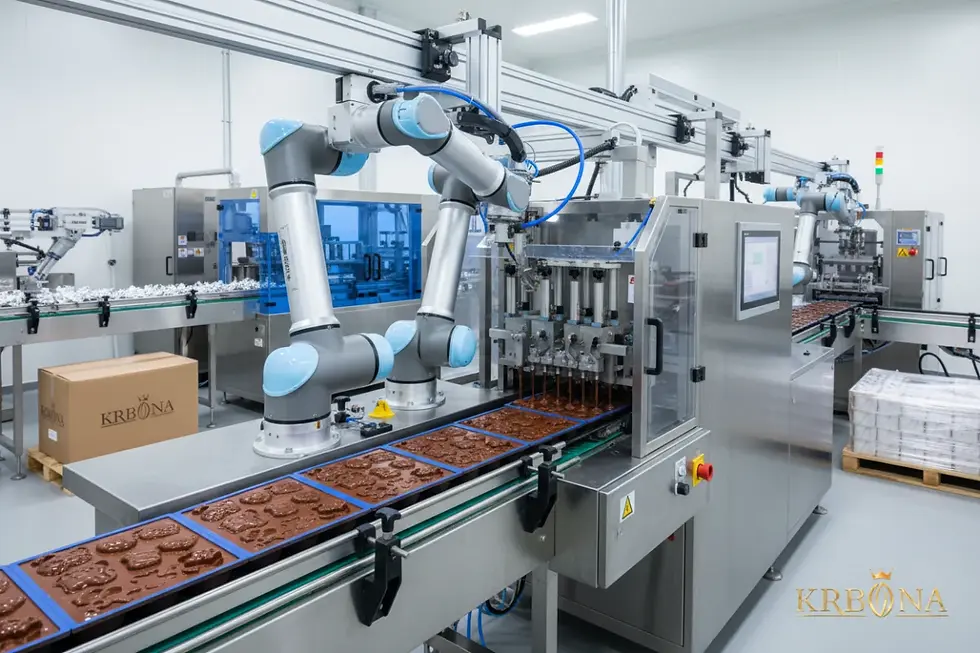
By operating state-of-the-art in-house CNC tooling, SFKS acts as a premier 3D custom molded chocolate factory and custom shape confectionery manufacturer. This setup enables rapid 3D mockup generation while maintaining strict IP confidentiality—ensuring that your copyrighted character designs are never leaked to competitors. Our flagship private brand, KRBONA, demonstrates our commitment to design excellence and market-ready aesthetics.
Furthermore, SFKS's proprietary ambient-stable chocolate snacks, such as our popular Ice Cream Flavor Crispy Cones, eliminate the logistical headaches of shipping confectionery. Importers in hot climates save thousands of dollars on shipping fees because our compound chocolate formulations maintain their structure and snap under normal ambient shipping conditions. Backed by 12 automated production lines, a daily capacity exceeding 120 tons, and comprehensive Halal and BRC certifications, SFKS handles seasonal scaling seamlessly, ensuring your retail rollouts launch on time and stay highly profitable.

A Practical Sourcing Checklist for IP Brand Managers
Before signing a contract with any of the top 10 candy OEM manufacturers for IP brands, run through this checklist to verify their technical capability:
Verify Mold Ownership: Does the contract clearly state that you own the custom CNC molds and that they cannot be reused for other clients?
Request Thermal Stability Reports: Ask for heat chamber test results showing how the chocolate or candy behaves at 35°C+ to ensure ambient-stable performance.
Audit Packaging Capabilities: Ensure the vendor is a qualified licensed candy packaging OEM capable of high-precision printing for character art, premium secondary boxes, and protective food-grade materials.
Assess Fast Sampling Timeframes: Can they deliver physically molded, edible samples within 7 days of receiving your 3D digital assets?
Confirm Global Certifications: Request active certificates for BRC, Halal, HACCP, and GMP to guarantee smooth border clearance.
Partner with a Trusted Novelty Candy Manufacturing B2B Expert
Launching a licensed confectionery line is an investment in your brand's reputation. By moving away from cheap commodity suppliers and partnering with an OEM that understands the commercial value of visual differentiation, you protect your retail margins and build a defensible market presence.
SFKS Food combines precision in-house CNC mold manufacturing with tropical-stable formulations, providing a turn-key solution for IP holders worldwide. Whether you need a whimsical 3D character chocolate or custom-molded biscuits, our team is equipped to turn your vision into a high-margin retail reality.
Ready to elevate your confectionery line and eliminate shipping risks? Request the IP Candy OEM Development Checklist today and connect with our design engineers to review your custom character assets.
Follow SFKS for more premium chocolate OEM insights:
Website: https://sphinxcandy.com
YouTube: https://www.youtube.com/@Sfks_Candy
TikTok: https://www.tiktok.com/@sfks_candy
Instagram: https://www.instagram.com/sfkscandy/
Facebook: https://www.facebook.com/profile.php?id=61578451330648
X: https://x.com/SPHINXFOOD
LinkedIn: https://www.linkedin.com/in/sphinxfood/
FAQ
What makes a manufacturer one of the top 10 candy OEM manufacturers for IP brands?
The best OEMs for IP brands distinguish themselves through high-fidelity mold reproduction, in-house CNC tooling to protect IP designs, certified food safety compliance (BRC, Halal, GMP), and advanced formulation capabilities that prevent products from melting or deforming during shipping and distribution.
Why is in-house CNC tooling critical for a custom shape confectionery manufacturer?
In-house CNC tooling allows for rapid prototyping (creating 3D chocolate mockups in days rather than weeks) and ensures complete intellectual property security. Because the design process remains entirely within the factory, there is no risk of proprietary character designs leaking to third-party mold makers.
How does a licensed candy packaging OEM protect retail margins?
An experienced licensed packaging OEM provides retail-ready, high-durability packaging customized to strict brand standards. By ensuring proper sealing and attractive structural design, they minimize shelf damage, extend product shelf life, and significantly increase the premium perceived value of the product.
Can a 3D custom molded chocolate factory manufacture products suitable for warm climates?
Yes, specialized factories like SFKS engineer ambient-stable compound chocolate formulations with higher melting points. This ensures that the intricate 3D shapes do not deform or suffer from fat bloom during transit and warehousing in tropical climates, eliminating the need for reefers.
What certifications are required for novelty candy manufacturing B2B export?
To successfully export novelty confectionery globally, manufacturers should possess internationally recognized food safety and quality standards, including BRC, HACCP, GMP (100,000-class cleanroom), FDA registration, and Halal certification to access high-growth Middle Eastern and Southeast Asian retail channels.


Comments